Is it better to invest in Colombia or diversify your wealth in another country?
The short answer: it is not about choosing between Colombia and abroad, but about deciding what proportion of your wealth should depend on a single country, a single currency and a single tax system.
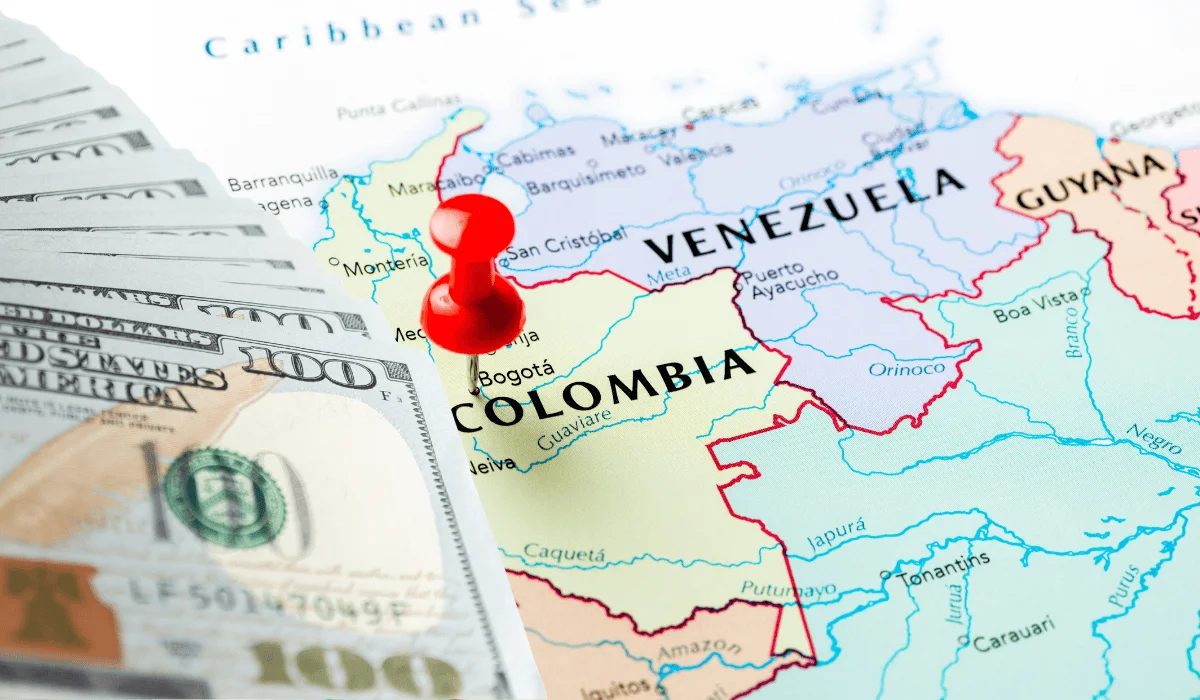
Few questions come up as often in our meetings with Colombian investors as this one. And in 2026 it is particularly relevant: the peso has had one of its best years against the dollar, inflation remains above the Banco de la República's target, interest rates remain high and the country is going through an election year with frequent tax adjustments.
In this article, we explain, using current data, what investing in Colombia offers, the risks of concentrating all your wealth at home and how to build an international diversification strategy that makes sense for your profile.
What Colombia offers investors today
Investing in Colombia has real advantages that should not be underestimated.
- Knowledge of the market. You know the neighbourhoods, developers, appreciation patterns and local regulations. That informational advantage reduces mistakes.
- Attractive nominal returns on fixed income. With the Banco de la República's rate at 12.25% following its October 30, 2026 meeting, certificates of deposit (CDTs) and government debt offer high returns in pesos (BBVA Research).
- A stronger peso. The exchange rate fell by around 14% in twelve months, and the dollar has traded at around COP 3,150–3,250 in recent weeks (Portafolio). This makes buying dollar-denominated assets cheaper in pesos today than a year ago.
- A property market with structural demand. Cities such as Bogotá and Medellín, and those along the coast, continue to face housing shortages and demand for rentals.
In summary: Colombia can and should be part of your portfolio. The question is whether it should be your entire portfolio.
The risks of concentrating all your wealth in a single country
The greatest risk is not investing in Colombia; it is depending exclusively on it. These are the factors that carry the most weight:
- Currency risk. Your wealth, income and expenses are in pesos. If the peso were to depreciate, your international purchasing power (your children's education abroad, travel, healthcare and retirement) would drop sharply. Analysts such as Credicorp Capital project a dollar close to COP 3,600 by the end of 2027 (Portafolio), showing that the current appreciation is no guarantee of permanence.
- Persistent inflation. Annual inflation reached 6.29% in September 2026, more than double the 3% target, and the market expects the target to be missed for the sixth consecutive year (GBM / Reuters). A high nominal return can be modest in real terms.
- Tax instability. In 2026, wealth tax was modified several times through emergency decrees, with changes to thresholds and rates, and was extended to legal entities (Rankia). For an investor, unpredictable rules are a cost in themselves.
- Political and fiscal risk. The pending fiscal adjustment will be decisive for Colombian markets in 2027 (Portafolio). Any deterioration affects the peso, interest rates and the appreciation of local assets simultaneously.
- Correlation across all your assets. When your business, home, investments and income depend on the same economy, a crisis hits them all at once. That is exactly what diversification seeks to avoid.
What international diversification means
Diversifying is not about "taking money out of the country". It is about building part of your wealth in assets that respond to another economy, another currency and another legal framework. For Colombian investors, real estate is often the most natural starting point: it is tangible, generates rental income and can open the door to residency.
Panama: dollarized, nearby and offering residency through investment
- A dollarized economy, with no exchange-rate risk against the dollar.
- A territorial tax system: generally, only income from Panamanian sources is taxed.
- Permanent residency as a Qualified Investor with a minimum real estate investment of US$300,000, free of liens and funded from abroad (EY).
- Proven demand: between July 2025 and June 2026, 268 Qualified Investor certificates were granted for US$113.6 million (Revista E&N), and real estate accounted for 87.3% of the certificates issued (Revista E&N).
- Proximity: a flight of just over an hour from Bogotá or Medellín, with the same time zone and language.
United States: liquidity and market depth
The world's most liquid real estate market, with financing available to foreign buyers and a wide range of rental properties. It requires appropriate structuring (for example, through an LLC) to address estate taxes and withholding taxes for non-residents.
Spain and Europe: euro exposure and lifestyle
Attractive for families seeking exposure to the euro, education for their children or a second home base. Colombians also have a preferential route to Spanish nationality after two years of legal residence.
The choice depends on your goal: protection in dollars, rental income, residency, lifestyle or a family legacy.
Colombia vs. international diversification: a quick comparison
Swipe to view the full comparison.
| Criterion | Colombia only | Diversified portfolio (Colombia + abroad) |
|---|---|---|
| Currency | 100% pesos | Pesos + dollars (and/or euros) |
| Currency risk | High | Mitigated |
| Nominal return | High in fixed income (rates of 12%+) | Mixed: dollar-denominated rental income, lower rate but a strong currency |
| Stability of tax rules | Frequent changes in 2026 | Spreads regulatory risk across jurisdictions |
| Knowledge of the market | High | Requires reliable local advice |
| Mobility and residency | Not applicable | Possible residency (e.g. Panama from US$300,000) |
| Protection against a local crisis | Low | High |
| Management complexity | Low | Medium: structuring, compliance and reporting |
How to diversify correctly: 6 steps
- Define your goal. Do you want to protect wealth in dollars, generate rental income, obtain residency or prepare a family legacy? The goal determines the country and the type of asset.
- Set a proportion, not an all-or-nothing choice. Many investors begin by moving between 20% and 40% of their liquid wealth abroad, adjusting over time according to their profile.
- Take advantage of the exchange-rate environment. With a strong peso, each dollar costs less. Staggering currency purchases across several instalments reduces the risk of entering at a bad moment.
- Meet your obligations in Colombia. If you are a Colombian tax resident, you must declare your assets abroad, and they count for income and wealth tax purposes. Diversifying is not evading: it is planning.
- Structure before buying. Decide whether to purchase in your own name, through a company or through a private interest foundation, taking taxes, succession and asset protection into account.
- Work with an adviser who knows both sides. A common mistake is buying abroad using local criteria. You need someone who understands the destination market and the circumstances of Colombian investors.
This article is for informational purposes and does not constitute tax, legal or financial advice. Each case should be reviewed with your advisers.
Conclusion: Colombia and the world, not Colombia or the world
Investing in Colombia still makes sense: it is your market, you know it and it offers real opportunities. But keeping 100% of your wealth in a single country, a single currency and under frequently changing tax rules is a concentrated bet, not a strategy.
The smart decision is to combine: keep your investments in Colombia and build, in an orderly and lawful way, a portion of your wealth in dollar-denominated assets that provide stability, rental income and mobility options for your family.
Frequently asked questions
Is it legal for a Colombian to invest abroad?
Yes. What matters is channelling the funds through the foreign exchange market and declaring assets abroad to the DIAN if you are a tax resident.
How much do I need to obtain residency in Panama by investing in property?
Permanent residency as a Qualified Investor requires a minimum real estate investment of US$300,000, free of liens and funded from abroad.
Is this a good time to buy dollars?
With the peso at strong levels, the peso cost of a dollar-denominated asset is lower today than a year ago. Nobody can predict the exchange rate, which is why we recommend buying in instalments.
What percentage of my wealth should I hold outside Colombia?
It depends on your age, goals, liquidity and family structure. A common starting range is between 20% and 40%, adjusted with your adviser.